How to Export Your Transaction History from Lightyear
Lightyear's account statement holds every order, dividend and deposit on your account, and it downloads as a CSV. That is the file to bring here. It is also one of only three files from which we record the dividends you received, with the tax the file states for each.
This guide covers the statement as Lightyear's walkthrough describes it. It explains where to find it, what to check, and what the import does with each kind of row.
Which Lightyear file do you need?
You need the account statement, as a CSV. Lightyear's help describes what it contains: your orders, dividends, interest, deposits and withdrawals. The import reads the orders and the dividends and skips the rest.
Lightyear offers other statements that sound close:
- The income statement and the capital gains statement summarise a period. They are not a history of your trades.
- The account statement as a PDF is for reading. The import needs the CSV.
Step 1: Open the statement export
Lightyear described this export in a walkthrough for its Spanish customers, published in English in February 2026. In your account, open Transactions, then Download report, then Account statement.
We have not confirmed those labels in every country, in the Dutch app, or on the web as well as in the app. Lightyear's help center describes the account statement as a PDF only. If your screen offers no CSV, the import cannot read the statement yet.
If you hold more than one Lightyear account, open the one whose trades belong in this portfolio first. Export the others separately.
Step 2: Start on the day you opened the account
Set the start date to the day you opened the account, as Lightyear's walkthrough also advises. The end date can be today.
A statement that starts later holds your recent sales and none of the purchases behind them. Nothing has to go wrong for this to happen. The file can import without a single error and still produce a cost basis that is wrong.
Step 3: Export the CSV and leave it as it is
Choose Export CSV. Upload the file exactly as it downloaded. Opening it in a spreadsheet to look at it is fine. Saving it from there is the risk.
The statement writes dates day first with a time, as in 27/07/2026 13:30:01, and numbers with a full stop as the decimal point, as in 70.98. A spreadsheet can rewrite either one. A date it turns round, or a price saved with a decimal comma, is something the import cannot read correctly.
Check you got the right file
Open the file in a preview, or in a text editor you close without saving. The first line holds the column names, often each in double quotes: Date, Reference, Ticker, ISIN, Type, Quantity, CCY, Price/share, then Gross Amount, FX Rate, Fee, Net Amt. and Tax Amt..
In the rows below, the Type column says what each row is: Buy, Sell, Dividend, Distribution, Deposit, Conversion and others.
If a column the import needs is missing, it stops before booking anything, with a message such as: "Lightyear parser: column 'Reference' not found. Please verify this is a Lightyear account statement." The column named changes with what is missing. Go back to the export rather than adding a column by hand.
Step 4: Drop it into DividendAtlas
Open the import panel and drag the file onto it, or click to pick it from your downloads folder. We recognise a Lightyear statement from its columns, so with those intact there is no broker to choose and no columns to match. A file that has lost several of them falls back to the general CSV route, which guesses the columns and can get them wrong, so export it again instead.
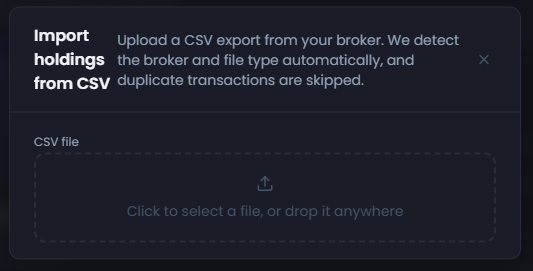
Each row of the statement normally carries its own reference. A trade whose reference is already in this portfolio is skipped. A trade with an empty reference is matched on its details instead, which cannot tell two identical orders from one order seen twice. A dividend is skipped only when its reference and its amounts both match. After an upload that overlaps an earlier one, check how many trades the result says it skipped as already imported.
What does the import bring in, and what does it leave out?
Trades. Every Buy and Sell row becomes a purchase or a sale, with its date, quantity, price per share and currency, matched by its ISIN, or by its ticker when the row has no ISIN. A row can still be rejected, for example when its date cannot be read, or stay unmatched when we cannot place the security. Fractional quantities keep all the decimal places the file gives. If the statement gives a London price in pence, with the code GBX, we convert it to pounds. The Fee column is not added to the price, so a holding's cost here can differ from the one Lightyear shows.
Dividends. A row of type Dividend becomes a payment received when we can read it. We take the gross from Gross Amount and the tax from Tax Amt., and a row with an empty tax cell is recorded with no tax. A dividend row is skipped without a message when its ISIN, date, amount or currency cannot be read, when the gross is zero or the tax is larger than it, or when the file has no Gross Amount column. Lightyear, Trade Republic and DeGiro's Dutch-language account statement are the three sources we read payments from today.
If you turn on net dividends, we can suggest the rate withheld from each holding, measured from these payments. For a portfolio whose residence is Germany, that suggestion appears only after you tell us, in the net dividends settings, that your broker is not based in Germany. The difference between a payment and our own dividend data is explained in how to check a dividend figure.
Each holding the import matches also shows the dividend history and forward income we hold for it. It shows its Dividend Health Score too, where we publish one.
The import leaves out four kinds of row, all without a message in the result:
- Distributions. Some fund payouts have the type Distribution rather than Dividend. We do not record those as payments yet.
- Dividend rows we cannot read, for the reasons above.
- Cash movements: deposits, withdrawals, currency conversions, interest and cash rewards.
- Any other row, which is anything that is not a Buy, a Sell or a Dividend. If Lightyear records a share split or a merger as a row of its own, the import skips it, and your share count changes without the result saying so.
What if the result does not look right?
- The file is refused outright. It is the PDF statement, not the CSV. Go back to step 3 and choose Export CSV.
- The import says the Date column is missing, although the file has one. Open the file in a text editor and look for a space before the first column name. Delete that space and save from the text editor, which changes nothing else.
- Sales with no matching purchases. Usually the start date was too late, so export again from the day you opened the account. Shares you moved in from another broker cause it too, because they are not booked from this statement.
- A holding shows the wrong number of shares. Check whether the company split its shares or merged, because such a row is skipped without a message. Shares you moved in from another broker are not booked either.
- Dividends from a fund are missing. Lightyear probably labelled them Distribution, which is not recorded yet.
- Some rows were not imported. The import result says how many and why. A security we cannot match is listed there rather than guessed.
Using other brokers too? Where to find your transaction history names the file to take from each broker we import. The guides for DeGiro, Trading 212, Interactive Brokers, Saxo, Trade Republic, Revolut and Nordnet cover theirs step by step.
Frequently asked questions
- Where is the CSV export in Lightyear?
- A walkthrough Lightyear published for its Spanish customers gives the route as Transactions, then Download report, then Account statement, then Export CSV, with the start date set to the day you opened the account. Lightyear's help pages describe the same statement as a PDF only, and we have not confirmed the CSV route for every country.
- Will the import record the dividends Lightyear paid me?
- Yes, for rows of type Dividend that we can read. Each becomes a payment received, with the gross amount and the tax the row states, and an empty tax cell is recorded as no tax. A dividend row we cannot read, and every row of type Distribution, is skipped without a message.
- I have more than one Lightyear account. What should I do?
- Export a statement for each account and upload each one into the portfolio it belongs to. We import a file into the one portfolio you choose, so two accounts in one portfolio end up merged.
- Can I upload two statements that overlap?
- Usually, if both go into the same portfolio. Each row normally carries its own reference, and a trade whose reference is already there is skipped. A dividend is skipped only when its reference and its amounts both match. Check the counts afterwards, and keep the files as they downloaded.
- Are fractional shares imported?
- Yes. The statement writes quantities with many decimal places, and we keep every one of them, for purchases and for sales.
DividendAtlas provides data and research for informational purposes only. Nothing here is investment advice, tax advice or a recommendation to buy or sell any security. Always do your own research.